
A HOSA team can take on mental health, but framing decides whether the project protects or harms. Whether you are an iHOSA BCE team in the mental-health direction or a team entering HOSA's Mental Health Promotion event, five rules do most of the work: no method or location detail, no single-cause story, no suggestion that suicide is a way out, a visible route to help and recovery, and a disclosure plan agreed with a named adult before anyone teaches.
Why a well-meant awareness message can backfire
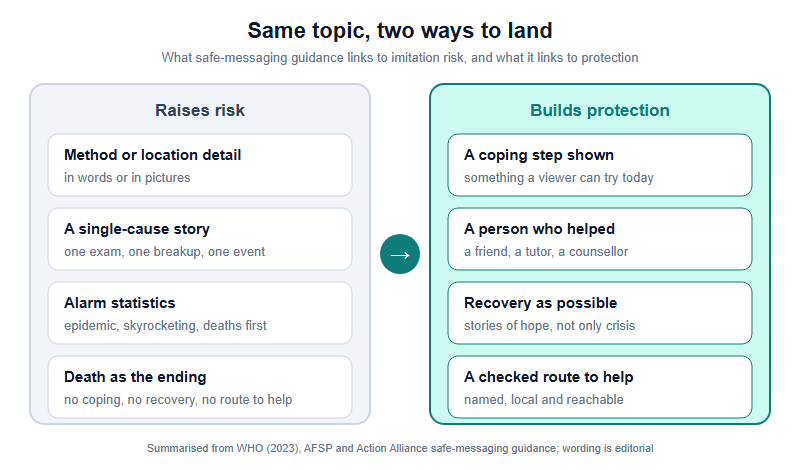
Unsafe mental-health content made by students is rarely careless. It comes from a sensible-sounding instinct to make the problem feel urgent: a shocking claim in the first second, a dramatic image, a story that ends in a death. International guidance on suicide communication warns against each of those choices.
The evidence behind the warnings runs in two directions. The World Health Organization's guidance describes the Werther effect, in which vulnerable people imitate suicidal behaviour after exposure to irresponsible coverage. The mirror image came later. In 2010, Niederkrotenthaler and colleagues reported in the British Journal of Psychiatry that news items about people who came through a suicidal crisis were associated with lower suicide rates, which they called the Papageno effect. A 2022 systematic review and meta-analysis in The Lancet Public Health then found that stories of hope and recovery had a small, short-term protective effect on suicidal thoughts among people with some vulnerability, while the evidence on help-seeking intentions was still too thin to call either way.
WHO's 2023 update of its resource for media professionals, produced with the International Association for Suicide Prevention, expanded the two areas a student team touches: stories of survival, hope and recovery, and online and social media. Its primary audience is media professionals, but WHO also addresses it to anyone who communicates publicly about suicide — and a 30-second advertisement posted online is public communication.
One honest limit: this research studies news and entertainment, not student projects, so applying it to a HOSA deliverable is our editorial judgment. The principle still transfers — reduce what could be imitated, and increase what models coping and help.
What HOSA's own guideline builds in
HOSA's 2026–2027 guideline for Mental Health Promotion is worth reading even if you never enter the event, because it shows how the organisation itself designs a student mental-health project. The event rests on the idea that mental health is health. A team of two to six creates and publishes a social-media campaign for its peers, centred on building protective factors around a chosen topic; the campaign is pre-judged digitally, and the team then gives a five-minute verbal presentation. Check the current version on hosa.org before relying on any detail.
| Safeguard in the 2026–2027 guideline | What it prevents | How an iHOSA BCE team can borrow it |
|---|---|---|
| A named Mental Health Consultant (a school counsellor, nurse or psychologist, or a community mental-health professional; the local advisor only if none is available) oversees project content | Publishing framings no professional has checked | Ask the school counsellor to review the script and lesson plan before filming or teaching, and keep a dated note of what changed |
| Campaigns centre on risk and protective factors for young people | Content that dwells on symptoms or crises | Build the message on a factor you can strengthen: connection, sleep, a trusted adult, a coping skill |
| The worked example redirects a self-harm concern towards bullying and peer conflict | Depicting the harm itself | Work on the upstream factor, and never show the behaviour |
| Guidance on disabling comments, added to the General Rules and Regulations for 2026–2027 | Unmoderated replies under a sensitive post | Switch comments off, or agree who moderates and how often |
| Dedicated or chapter accounts, not personal ones | Strangers and judges reaching students' private profiles | Open a project account, and never post from a team member's own profile |
| A consultant form that rates advice-taking on how, when and where to seek help | Campaigns with no route to support | Put a checked support route in every deliverable |
The worked example is the most instructive line in the document. Faced with a self-harm concern in a school, the model team does not build a campaign about self-harm. It identifies risk factors — bullying, peer conflict, violence witnessed at home — and builds the campaign around navigating bullying and resolving conflict. A second example turns social isolation and signs of depression into a campaign about connection through extracurricular activities. In both, the harm is the reason for the project, not its content.
iHOSA runs its own rules, but the logic carries. Per Hanlin's season briefing, the BCE self-proposed route includes a mental-health direction, and every team produces a 30-second public-service advertisement and a public-health class for a real audience; our comparison of the ATC, CCE and BCE tracks shows where BCE sits in the season. Borrowing HOSA's safeguards costs nothing and gives a team a far better answer when a judge asks how it handled a sensitive topic. Confirm current iHOSA requirements on the official channels.

The script audit: seven checks for the advertisement and every post
Run every line of the script, every frame of the storyboard and every caption through these checks. They draw on the safe-messaging guidance of the American Foundation for Suicide Prevention (AFSP) and the US National Action Alliance for Suicide Prevention, and on the media guidelines of Beat, the UK eating-disorder charity.
- No method, means or location. Not in words and not in pictures: no pills, rooftops, bridges, blades or notes. AFSP warns that method details can trigger people who are struggling and may contribute to contagion.
- No single cause. “She failed the mock, so…” is an easy storyline for a student script, and a misleading one. The guidance is that suicide follows a combination of factors, never one event.
- Never a way out. Nothing that presents suicide as honourable, romantic, or a reasonable option for someone in pain.
- Language that does not accuse. Say “died by suicide” or “took their own life”. Avoid “committed”, which carries the stigma of a crime, and never describe an attempt as successful, unsuccessful or failed.
- No alarm statistics. Write “rates rose” rather than “epidemic” or “skyrocketing”, and do not open on a death count. The Action Alliance notes that problem-only statistics can make suicide look overwhelming and unsolvable, which discourages action.
- A positive narrative plus a concrete route. Show a coping step, a recovery or a person who helped, and end on help a viewer can actually reach.
- For eating and body image, no numbers. Beat advises against weights, BMI, measurements or calories, and against images of emaciation, empty plates, scales or tape measures — or the stereotyped person with head in hands, a stock shot worth dropping from any mental-health video.
Applied to a draft, the checks can shorten the script as well as make it safer:
| Draft line | What the checks flag | Safer rewrite |
|---|---|---|
| “Exam stress is killing students.” | Single cause, alarm framing, opens on death | “Exam weeks are heavy. Heavy is worth saying out loud.” |
| Shot: a student alone on a rooftop | Location imagery | Shot: two students walking towards the counsellor's office |
| “Don't let it be you.” | Blame and fear, with no action | “If a week feels too heavy, tell one adult today.” |
| “Talk to someone.” | No named, reachable route | “Your tutor, the counsellor or a parent. You do not need the right words first.” |
At roughly 75 spoken words in thirty seconds — the planning estimate in our guide to the two BCE deliverables — there is no room for a statistic, a tragedy and a support route, so keep the support route. The same checks apply to Chinese subtitles and captions: ask your reviewer to read both languages, because a phrase that sounds neutral in one can carry blame in the other.
Before you teach: a disclosure-ready class
The public-health class carries a risk the advertisement does not: a real person may respond in the room. A student listening to a session on stress may realise mid-activity that what they are living with has a name, and tell the nearest person — who may be a Year 11 presenter. A team with no plan is left to improvise, and improvising usually means promising secrecy, trying to counsel, or telling no one.
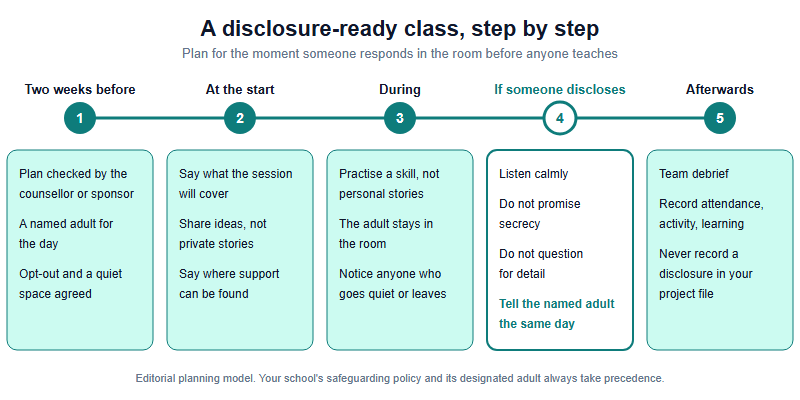
- Two weeks before: share the lesson plan with your counsellor or staff sponsor, confirm the designated adult for the day, and agree an opt-out and a quiet space.
- At the start: say what the session covers, set a norm of sharing ideas rather than private stories, and say where support is.
- During: practise a skill rather than collecting stories, keep the adult in the room, and notice anyone who goes quiet or leaves.
- If someone discloses: listen calmly, never promise secrecy, do not question for detail, and tell the designated adult the same day.
- Afterwards: debrief, and record attendance, the activity and an anonymous learning check. A disclosure belongs to the school's safeguarding process, never to your project file.
Match the content to the audience's age. For a primary section or a Year 7 group, teach protective skills — naming a feeling, asking an adult, making a friend in a new school — and leave suicide and self-harm out entirely. With older audiences, recognising when a friend needs more than a friend can give is valuable, but it is stronger co-delivered with the counsellor.
The same caution applies to evidence. Do not ask about suicidal thoughts or self-harm in a student-run survey; those answers bring a duty of care your team cannot discharge. Measure what you taught instead — whether learners can name two sources of support — anonymously and with the counsellor's agreement.
Finally, name support routes you have checked with the school. For most China-based schools that means the counsellor, a trusted adult, and 12356, the national psychological assistance hotline designated by China's National Health Commission, which required the number to work nationwide by 1 May 2025. Local lines must run at least 18 hours a day, so for immediate danger the answer is emergency services, not a hotline. Schools outside mainland China should use the local service their counsellor confirms.
Choosing an angle judges and readers will trust
The safest projects are rarely the least ambitious. They pick a protective factor and do something measurable with it. As a working guide:
- Strong fit for student-led work: sleep routines in exam weeks, connection for students new to a school, a notification-free hour before bed, knowing who to talk to and how to start.
- Workable with counsellor co-design: stress and anxiety literacy, bullying and peer conflict, recognising when a friend needs adult help.
- Address upstream, not head-on: suicide, self-harm and eating disorders as the headline subject. As HOSA's own example shows, a project can respond to these concerns through their risk and protective factors without making them the content.
The payoff is not only safety. A team that can explain why it cut a statistic, how its reviewer changed the script and what it would have done after a disclosure is showing the judgment health professions look for. It reads the same way later: an admissions reader weighs an activity against the essay, the recommendation and the record of what was delivered, and careful work gives each of those sources the same story to confirm. For where HOSA sits in a pre-health profile, start with our HOSA overview.
Frequently asked questions
Can a HOSA project be about suicide prevention?
Yes, if it builds protective factors and help-seeking rather than showing harm, a mental-health professional reviews the content first, and the organiser confirms the topic fits.
Which words should a mental-health PSA avoid?
Avoid committed, successful or failed attempt, epidemic and any method or location detail. Say died by suicide and end on a route to help.
Does HOSA Mental Health Promotion need an expert?
Yes. The 2026-27 guideline asks teams to name a Mental Health Consultant for content oversight; the advisor can serve if no one else can.
Which support line can a China-based team show?
Check with your school first. China has a national psychological assistance hotline, 12356; for immediate danger, call emergency services.
Published by the HOSA (SKT-iHOSA) editorial desk, operated by Hanlin Education for China-based international-school students. Official rules are set by the competition and change yearly — confirm current details on hosa.org. Any error will be corrected within 7 working days.

Oct 20, 2026
iHOSA ATC Division I vs II: Allocating Study Time by Weighting Differences
Students in grades 9-10 and 11-12 face different topic weightings in the iHOSA ATC Biology and Chemistry exams. This guide breaks down…
Oct 17, 2026
iHOSA Biology Explanations: Connect a Feedback Loop to a Change in the Body
Mastering negative and positive feedback loops is essential for iHOSA Biology. Learn how to connect physiological mechanisms to observable changes with worked…
Oct 15, 2026
iHOSA Health Education: Test Whether an Audience Understood Your Message
In iHOSA Health Education, testing whether your audience understood your message is not an afterthought—it is the core deliverable. Learn how to…