You can prepare for the iHOSA psychology paper without ever taking a psychology class. Use AP Psychology as your substitute textbook, because Hanlin's overlap mapping puts AP closest to the paper; work through its five content units, starting with cognition; keep the biological unit thin until you have checked the 2027 syllabus; treat research methods as a thread through everything; and rehearse the real format of 45 multiple-choice questions in 45 minutes, plus five tiebreakers.
Read the overlap table as a textbook choice, not a head start
Hanlin (SKT-iHOSA) has published how closely each ATC subject overlaps the main international courses. For psychology the figures are about 82% against AP, 75% against A-Level and 57% against IB (per Hanlin; confirm current figures on the official channels). Our ATC subject-choice guide reads those numbers the usual way: the higher the overlap with your own course, the more of the paper you already study in class.
If your school offers no psychology, that reading does not apply to you, because your overlap is zero in every column. What the table still tells you is which public course makes the best substitute textbook, and AP wins twice over. It has the highest overlap, and College Board publishes the full AP Psychology Course and Exam Description, unit by unit, on AP Central. You are not sitting the AP exam; you are borrowing its map.
One adjustment matters before you start. Per Hanlin's 2027 season briefing, the ATC syllabus was trimmed in every subject, and for psychology the cut was the chapter on the physiological basis of behaviour; our explainer on the 2027 reform lists the changes subject by subject. Our reading — not a published mapping — is that this most likely overlaps with what AP files under the nervous system, neurons and the brain. So keep that material thin until the current iHOSA syllabus is in your hands, rather than spending September on neuroanatomy that may not be examined.
Be honest about the cost, too. A student with no course is learning a subject, not revising one, in the same autumn term that holds school assessments. That is workable in about thirteen weeks if sessions are short and frequent; it fails if the plan is to read a textbook cover to cover. This plan assumes you are already entered on the ATC track (2027 registration closed on 20 August); for how it compares with the CCE and BCE tracks, our ATC, CCE and BCE comparison sets out the difference in workload.
The five-unit map, adapted for this paper
College Board organises AP Psychology into five units, each carrying 15–25% of the exam weighting. The table keeps College Board's unit names and adds what a student without a course should hold, where such students usually slip, and a planning note for the iHOSA paper.
| AP unit (share of AP exam) | What to hold | Where students without a course slip | iHOSA planning note |
|---|---|---|---|
| 1. Biological Bases of Behavior (15–25%) | How heredity and environment interact; sleep; sensation | Memorising brain regions with no function attached | Thin layer until the 2027 syllabus is confirmed; keep the basics other units lean on |
| 2. Cognition (15–25%) | Perception; thinking, judgments and decisions; encoding, storing, retrieving and forgetting; intelligence and achievement | Heuristic versus algorithm; the two kinds of memory interference | Start here: dense in scenario questions |
| 3. Development and Learning (15–25%) | Physical, cognitive and social-emotional development across the lifespan; language; classical and operant conditioning | Treating negative reinforcement as punishment; cross-sectional versus longitudinal designs | Conditioning items reward exact definitions |
| 4. Social Psychology and Personality (15–25%) | Attribution; attitudes and persuasion; conformity, obedience and groups; personality theories; motivation; emotion | Fundamental attribution error versus self-serving bias; conformity versus obedience | Learn what each classic study found, not its date |
| 5. Mental and Physical Health (15–25%) | Health psychology and stress; positive psychology; explaining and classifying disorders; selected disorder categories; treatment | Using a diagnostic label as if it were an explanation | Links directly to mental-health topics on the BCE track |
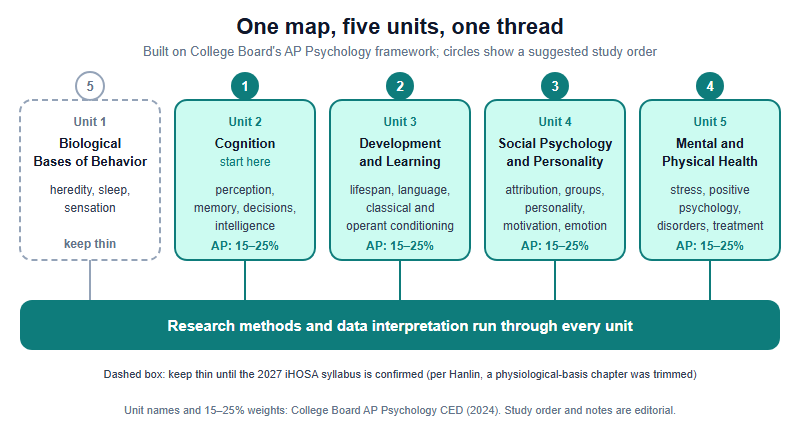
Start with Unit 2, not Unit 1. Cognition is where a newcomer builds psychological vocabulary fastest, and its ideas — memory, bias, problem-solving — reappear inside development, social psychology and health. Unit 1 moves to the end of the plan below for the reason already given: it is the part of this paper most likely to have changed.

Research methods are a thread, not a chapter
College Board assesses three of AP Psychology's four science practices in the exam's multiple-choice section, weighted at about 65% concept application, 25% research methods and design, and 10% data interpretation. That is AP's blueprint, not a description of the iHOSA paper. But because AP is the course closest to this paper, it is the best public signal of what psychology multiple-choice questions reward: mostly scenarios that ask you to apply a concept, with a steady minority about how a study was designed and what its data can show.
Methods therefore cannot wait until the end. Learn these ten distinctions in the first week and revisit them inside every unit:
- Independent versus dependent variable, and what an operational definition does
- Random sampling (who is studied) versus random assignment (who gets which condition)
- Experiment versus correlational study, and why a correlation cannot establish cause
- Confounding variables, and how a control group deals with them
- Placebo effects, and single-blind versus double-blind designs
- Reliability (consistency) versus validity (measuring the right thing)
- Cross-sectional versus longitudinal studies of development
- Mean, median and mode, and what skew does to them
- Statistical significance versus practical importance
- Research ethics: informed consent, deception with debriefing, protection from harm
Here is the kind of item those distinctions decide, written for this guide rather than taken from any paper. A survey of 400 students finds that those who sleep longer tend to earn higher grades. Which conclusion is justified? The tempting answer says more sleep causes better grades. The justified one says only that sleep and grades are related: nobody was assigned to sleep longer, and a third factor such as workload or anxiety could drive both. One minute, two methods concepts, and a trap built entirely from ordinary English.
The confusable pairs that cost second-language readers marks
Psychology gives everyday words technical meanings, and that is where fluent readers still lose marks. The largest single trap is in conditioning: negative means taking something away, not something unpleasant. Negative reinforcement makes a behaviour more likely by removing something aversive; punishment makes a behaviour less likely.
| Pair | The question that separates them | Anchor to remember |
|---|---|---|
| Negative reinforcement / punishment | Is the behaviour becoming more or less likely? | Reinforcement always strengthens a behaviour |
| Sensation / perception | Is the stimulus being detected or interpreted? | Sensation takes in; perception makes sense |
| Proactive / retroactive interference | Is old learning blocking new, or new learning blocking old? | Proactive works forward from the past |
| Fluid / crystallised intelligence | A novel problem, or stored knowledge? | Crystallised grows with experience |
| Conformity / obedience | Did an authority give a direct instruction? | Obedience needs a command |
| Fundamental attribution error / self-serving bias | Explaining someone else, or yourself? | Self-serving protects your own image |
| Heuristic / algorithm | A shortcut, or a step-by-step procedure that guarantees an answer? | Algorithms are slow but certain |
| Reliability / validity | Consistent results, or measuring the right thing? | A scale can be reliable and still wrong |
When a stem feels ambiguous, use a fixed routine instead of rereading: name the unit, name the concept family, find the single word that separates the two closest options, then eliminate. Most items turn on that word — ordered, removed, novel, consistent — and a reader translating sentence by sentence tends to skim past it.
A thirteen-week plan to the preliminary round
Per Hanlin's season briefing, the preliminary round falls in mid-to-late December 2026; confirm the exact date on the official channels and count back from it. From mid-September that leaves about thirteen weeks. The plan assumes four short sessions a week and moves the uncertain unit to the end.
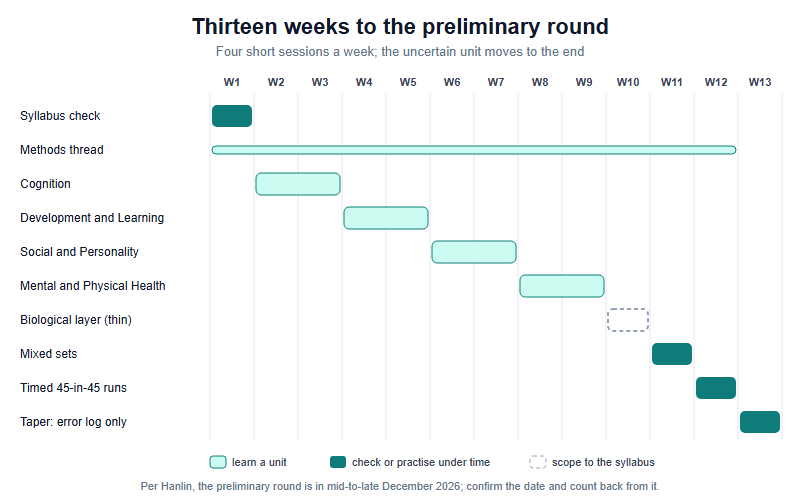
- Week 1: obtain the current syllabus and reference list, mark what matches AP and what does not, and start the ten methods distinctions.
- Weeks 2–3: Cognition.
- Weeks 4–5: Development and Learning.
- Weeks 6–7: Social Psychology and Personality.
- Weeks 8–9: Mental and Physical Health.
- Week 10: the biological layer, scoped to whatever the syllabus confirms.
- Week 11: interleaved mixed sets across all units.
- Week 12: two full timed runs of 45 questions in 45 minutes, with the hardest items saved for the end to stand in for tiebreakers.
- Week 13: taper with error-log review and recall practice, and no new content.
Keep an error log from week two and sort every miss into one of three bins: never learned it, knew it but too slowly, or misread the stem. Each bin has a different fix, and only the first is solved by more reading.
Keep the long view as well. An ATC psychology result reads most convincingly when the rest of a file points the same way — an extended essay or EPQ in the area, reading you can discuss, a related activity — because an admissions reader weighs each part against the others. For where a strong season can eventually lead, our ILC 2026 guide shows what HOSA's international stage looks like.
Frequently asked questions
Can I sit the iHOSA psychology paper without a psychology class?
Yes. Use AP Psychology as a substitute textbook, start with cognition and research methods, and confirm the current syllabus officially.
Why use AP Psychology rather than IB or A-Level?
Per Hanlin, the psychology paper overlaps AP most, at about 82 percent, and College Board publishes the full AP unit framework.
Should I study the brain and nervous system in depth?
Not at first. Per Hanlin, a physiological basis of behaviour chapter was trimmed for 2027, so confirm the syllabus before going deep.
What is the format of the online round?
Per Hanlin, 45 multiple-choice questions in 45 minutes plus 5 tiebreakers. Confirm the current format on the official channels.
Published by the HOSA (SKT-iHOSA) editorial desk, operated by Hanlin Education for China-based international-school students. Official rules are set by the competition and change yearly — confirm current details on hosa.org. Any error will be corrected within 7 working days.

Oct 20, 2026
iHOSA ATC Division I vs II: Allocating Study Time by Weighting Differences
Students in grades 9-10 and 11-12 face different topic weightings in the iHOSA ATC Biology and Chemistry exams. This guide breaks down…
Oct 17, 2026
iHOSA Biology Explanations: Connect a Feedback Loop to a Change in the Body
Mastering negative and positive feedback loops is essential for iHOSA Biology. Learn how to connect physiological mechanisms to observable changes with worked…
Oct 15, 2026
iHOSA Health Education: Test Whether an Audience Understood Your Message
In iHOSA Health Education, testing whether your audience understood your message is not an afterthought—it is the core deliverable. Learn how to…