
For families preparing for the iHOSA Psychology Revision track, a common stumbling block is the difference between knowing a definition and applying a concept. The 2027 iHOSA Behavioral Health syllabus covers genetics and environment, learning, memory, psychological disorders, and treatment methods. Students must demonstrate how psychological principles operate in specific contexts. According to operator notes from Hanlin’s course materials, this exam rewards dynamic reasoning over static recall. This article explains that mechanism, provides a worked teaching illustration, contrasts it with a common error, and offers a practical diagnostic method to ensure your preparation aligns with the exam’s objective format.
The Core Mechanism: Definition vs. Application
In the iHOSA online objective assessment, questions often present a scenario rather than asking for direct recall of terms. A definition states what a concept is (e.g., “Classical conditioning is learning through association between a neutral stimulus and an unconditioned stimulus”). An application identifies how that concept functions in a real-world situation (e.g., “A patient develops anxiety when entering a hospital because they associate the sterile smell with previous painful procedures”). The 2027 syllabus update notes that Behavioral Health has strong alignment with standard curriculum frameworks where application is consistently emphasized over mere recall. Understanding this shift from static knowledge to dynamic reasoning is critical for high scores on the timed online assessment.
Worked Teaching Illustration: Applying Classical Conditioning
Note: This is a hypothetical teaching illustration, not an official contest problem.
Consider the concept of Classical Conditioning.
Definition: A learning process in which a neutral stimulus becomes associated with an unconditioned stimulus, eventually eliciting a conditioned response when presented alone.
Application Scenario: After eating spoiled shellfish at a beachside restaurant, a person feels nauseous whenever they smell ocean air, even on occasions unrelated to food.
Analysis Steps:
- Identify the Unconditioned Stimulus (US): The spoiled shellfish, which naturally triggers nausea.
- Identify the Unconditioned Response (UR): Nausea and sickness caused directly by the spoiled food.
- Identify the Neutral Stimulus (NS): The ocean air, which had no prior effect on the person’s digestive system.
- Observe Pairing: The ocean air was present during the food poisoning episode.
- Result: The ocean air (now Conditioned Stimulus, CS) triggers nausea (Conditioned Response, CR) even in the absence of spoiled food.
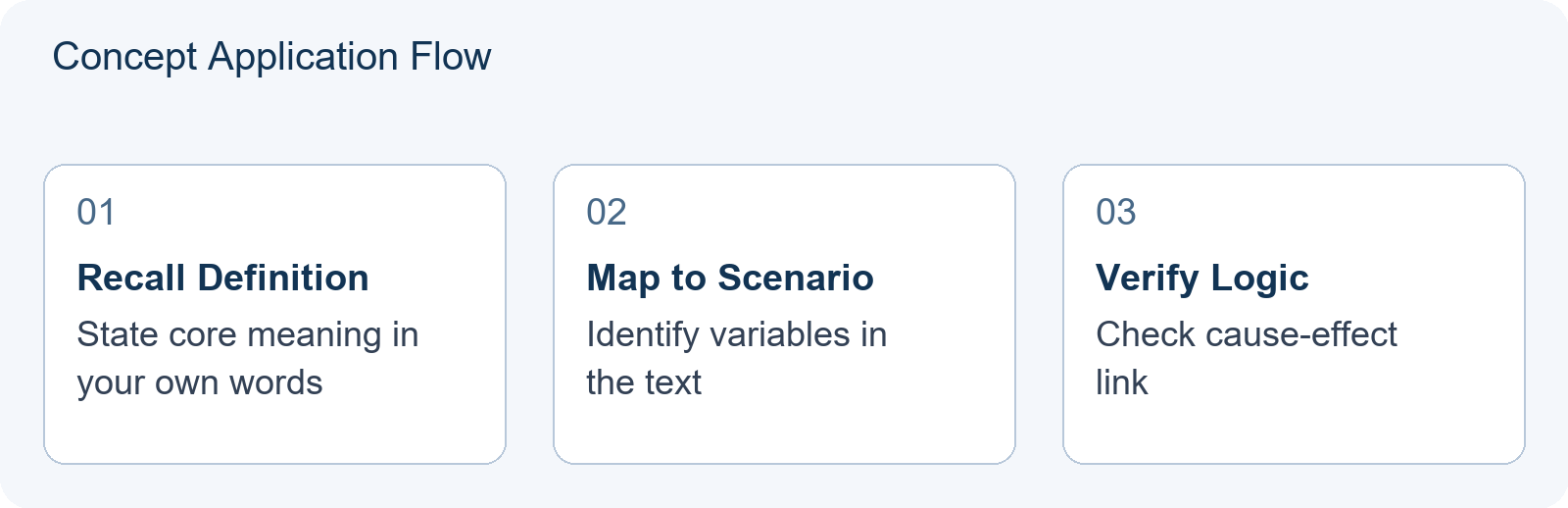
By walking through these steps, you move from defining the term to proving you understand its mechanism in context. The exam rewards this component-mapping skill.
Contrasting Case: Where Superficial Preparation Fails
A student relying solely on flashcard definitions might correctly identify that classical conditioning involves stimulus association. However, when faced with an application question such as, “In the scenario above, what is the conditioned stimulus?” they may confuse the US and CS because they have not practiced mapping variables to narrative details. Without explicitly labeling each component in multiple novel scenarios, the student cannot reliably distinguish whether a described element is the original trigger (US), the learned trigger (CS), or the response (CR/UR). This highlights why The iHOSA Psychology Paper Without a Psychology Class: A Unit-by-Unit Study Map for the Online Round (2026-27) emphasizes structured unit-by-unit study maps that build application skills, not simple vocabulary lists.
Second Teaching Illustration: Operant Conditioning and Reinforcement Schedules
Note: This is a hypothetical teaching illustration, not an official contest problem.
Definition: Operant conditioning modifies behavior through consequences, using reinforcement to increase behavior or punishment to decrease it.
Application Scenario: In a laboratory setting, a rat receives a food pellet after an unpredictable number of lever presses.
Analysis Steps:
- Identify the behavior: Pressing the lever.
- Identify the consequence: Receiving a food pellet.
- Determine the effect: The behavior of lever pressing increases.
- Classify the reinforcement: Variable-ratio reinforcement (unpredictable number of presses before reward), which produces high and persistent response rates.
A definition-only student might simply state that reinforcement increases behavior. An application-ready student recognizes the specific schedule and predicts the behavioral pattern.


Diagnostic Application: Self-Check Method
To verify your readiness, use this three-step diagnostic for any topic in the Behavioral Health syllabus:
- State the Definition: Can you explain the concept in one sentence without using the textbook’s exact wording?
- Generate a Novel Example: Can you create a scenario not found in your study materials that illustrates the concept?
- Identify Components: In your novel example, can you label the specific variables (e.g., US, UR, NS, CS, CR for classical conditioning; behavior, consequence, schedule for operant conditioning; encoding, storage, retrieval for memory)?
If you cannot complete step 3, your understanding is definitional, not applied. For instance, in the Memory unit, distinguishing between retrograde and anterograde amnesia requires identifying whether the deficit affects past or future memories—a component-labeling task, not a definition recitation.
Implications for Next Learning Tasks
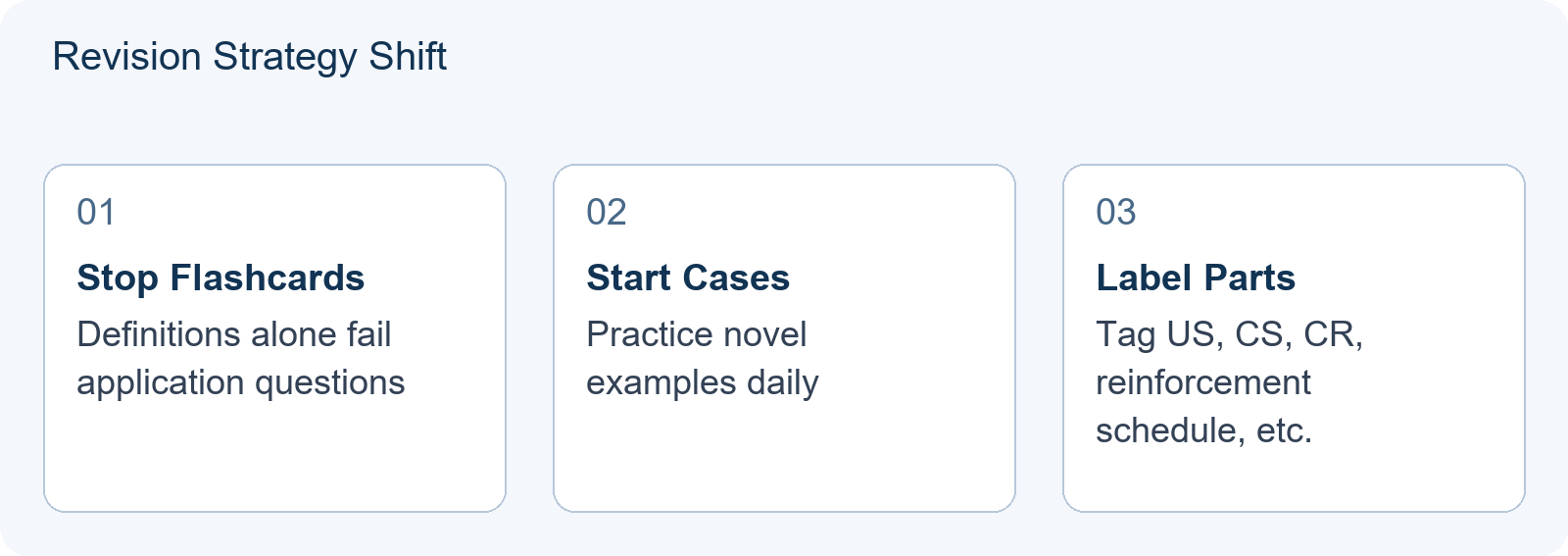
If your diagnostic reveals gaps in application, adjust your revision strategy. Instead of re-reading chapters, focus on case studies. The syllabus allocates substantial weight to Psychological Disorders and Treatment Methods. These sections are highly contextual. Practice matching symptoms to appropriate interventions and understanding how researchers evaluate treatment efficacy. This approach mirrors the skills needed for iHOSA Biology Data: Separating a Control Result From an Experimental Effect, where interpreting results is more valuable than recalling facts. Engage with resources that provide scenario-based questions, such as those suggested in iHOSA Biology vs Nutrition: Choosing a Preparation Focus for a Pre-Health Interest, which highlight the importance of cross-disciplinary application skills.
Preparation Context for Families
Families should note that iHOSA is an independent competition organized by HOSA-Future Health Professionals. According to Hanlin operator notes, it is not affiliated with Chinese school admissions systems. Participation is recognized for academic excellence but does not guarantee university admission. The focus here is on building genuine competency. For students balancing multiple subjects, understanding the distinct demands of each—such as the analytical nature of Psychology versus the factual density of Chemistry—is vital. Refer to iHOSA Chemistry Explanations: Connecting Particle Models to Observable Properties to see how particle models connect to observable properties, a similar application-based skill set.
Extinction vs. Punishment: A Critical Distinction in Behavioral Principles
The iHOSA Behavioral Health syllabus covers learning principles where students frequently conflate extinction and punishment. While both can reduce a behavior’s frequency, their mechanisms differ fundamentally. Confusing them leads to incorrect answers on application questions.
Definition of Extinction: The gradual weakening of a conditioned response that results in the behavior decreasing or disappearing because the reinforcement previously associated with it is no longer provided. In classical conditioning terms, this involves presenting the Conditioned Stimulus (CS) without the Unconditioned Stimulus (US).
Definition of Punishment: The application of an aversive stimulus or the removal of a desirable stimulus immediately following a behavior, which decreases the likelihood of that behavior recurring. Punishment introduces a new consequence; extinction removes an existing one.
Note: This is a hypothetical teaching illustration, not an official contest problem.
Application Scenario: In a laboratory learning task, a rat receives a food pellet each time it presses a lever. One day, the food dispenser stops working. The rat continues pressing the lever for a while, but the behavior gradually declines.
Analysis Steps:
- Identify the Behavior: Pressing the lever.
- Identify the Previous Reinforcer: Receiving a food pellet (positive reinforcement).
- Observe the Change: The food dispenser no longer releases pellets.
- Determine the Mechanism: The reinforcer (food pellet) is no longer delivered after the behavior. The response occurs, but the expected reward does not follow.
- Classify the Procedure: This is extinction, not punishment. No new aversive stimulus is added; the existing reward is simply withheld.
A common error is labeling any procedure that reduces behavior as “punishment.” However, in behavioral psychology, punishment requires adding something unpleasant or removing something pleasant as a direct consequence of the behavior. Here, the food pellet is simply absent; the lever press no longer produces its expected outcome. If the lever instead triggered a mild puff of air (adding an aversive stimulus), that would be positive punishment if it reduced subsequent lever pressing. If pressing the lever caused a running wheel to be removed (removing a desirable stimulus), that would be negative punishment if it reduced subsequent lever pressing.
Contrasting Case: Extinction Without Punishment
In a hypothetical classical-conditioning exercise, a tone has repeatedly preceded food, and an animal now salivates to the tone. Presenting the tone repeatedly without food can reduce that conditioned response: this is extinction. No unpleasant consequence has been added to punish salivation. The association between the cue and food has changed. Extinction does not guarantee permanent erasure; a response can later recover under some conditions. When classifying a new example, identify the cue, the expected outcome, and what changes during the learning sequence before choosing a label.
Self-Check Application
To verify readiness for questions on these principles, use this three-step check:
- State the Definition: Can you explain extinction as the cessation of reinforcement leading to response decline?
- Generate a Novel Example: Create a scenario where a student stops receiving points for completing optional quizzes, resulting in fewer quiz attempts.
- Identify Components: Label the behavior (completing quizzes), the previous reinforcer (points), and the change (points withheld). Confirm no new aversive stimulus was introduced.
If you cannot clearly articulate why withholding points is extinction rather than punishment, your understanding remains definitional. Review the distinction between removing a reward as a consequence (negative punishment) and stopping a reward pattern (extinction). Negative punishment removes a specific item or privilege immediately after a behavior; extinction stops reinforcing the behavior itself. This distinction lets you classify the procedure from what changes and what effect it has.
Frequently Asked Questions
How should I practise applying behavioural concepts?
Start with a definition, then label the cue, response and outcome in a hypothetical learning example. Compare a second example where only the consequence changes. Use the current regional syllabus to set your study scope; this exercise does not establish which other knowledge the exam excludes.
How many questions are in the online assessment?
According to Hanlin operator notes, the 2027 online objective assessment consists of 45 single-choice questions plus 5 tie-breaker questions, completed in 45 minutes.
Is this competition recognized for Chinese school admissions?
Official sources state it is an international activity and not linked to Chinese primary or secondary school admissions or merit evaluations.

Oct 20, 2026
iHOSA ATC Division I vs II: Allocating Study Time by Weighting Differences
Students in grades 9-10 and 11-12 face different topic weightings in the iHOSA ATC Biology and Chemistry exams. This guide breaks down…
Oct 17, 2026
iHOSA Biology Explanations: Connect a Feedback Loop to a Change in the Body
Mastering negative and positive feedback loops is essential for iHOSA Biology. Learn how to connect physiological mechanisms to observable changes with worked…
Oct 15, 2026
iHOSA Health Education: Test Whether an Audience Understood Your Message
In iHOSA Health Education, testing whether your audience understood your message is not an afterthought—it is the core deliverable. Learn how to…