
Why Attendance Alone Fails as a BCE Metric
Teams in the iHOSA BCE public-welfare track often default to counting heads at an event or views on a video. These numbers are easy to collect but reveal little about whether anyone changed what they actually do. A project evaluation built only on attendance risks describing activity, not impact.
The core difficulty in iHOSA BCE project evaluation is designing indicators that connect your specific intervention to a measurable shift in knowledge, attitude, or behavior—without access to clinical trials or long-term follow-up. This article works through two hypothetical teaching illustrations to show how to build that chain of evidence, and contrasts a common shortcut that collapses under scrutiny.
Worked Example 1: A 30-Second PSA on Sleep Hygiene
Project Design
A team of four students produces a 30-second public service announcement aimed at high schoolers, urging them to put phones away 30 minutes before bed. The team has no budget for pre-post surveys across their entire school. How should they evaluate whether the PSA caused any change?
Building Measurable Indicators
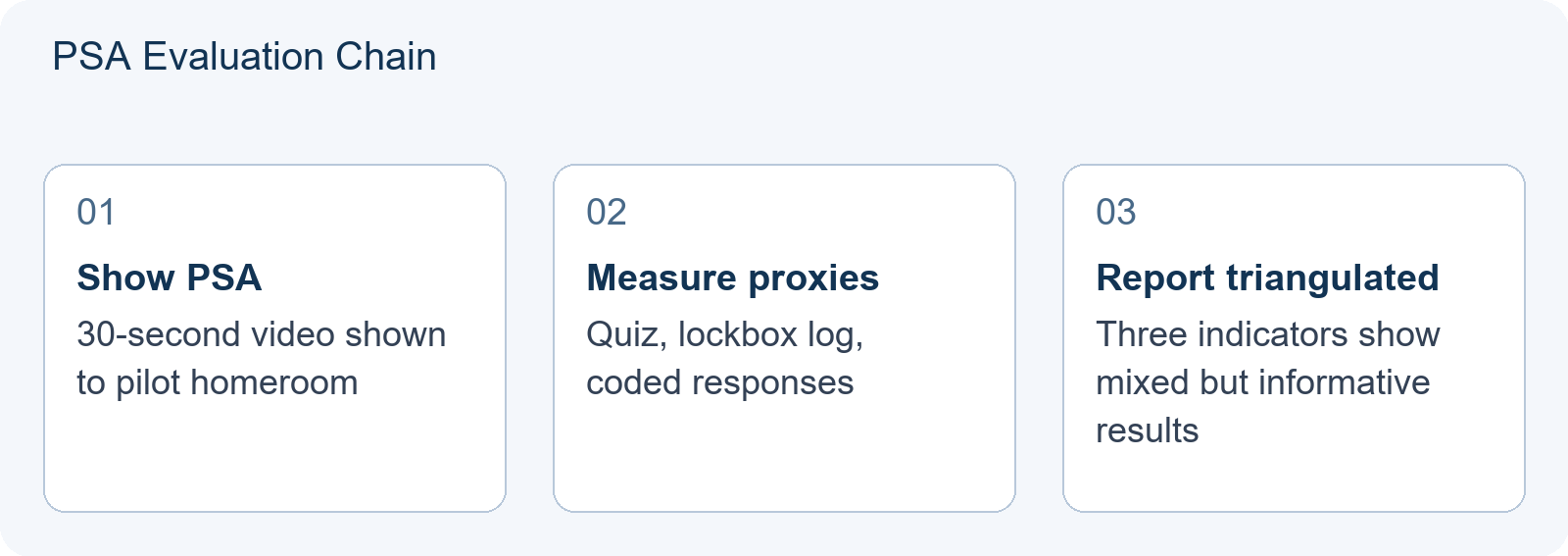
Instead of tracking views alone, the team structures their evaluation around a behavior they can observe in a defined group:
- Knowledge proxy: A five-item quiz on sleep hygiene administered to a single homeroom (n≈30) before and after the PSA is shown. The quiz is identical, administered one week apart, with no announcement that a follow-up is coming.
- Behavior proxy: A voluntary phone-lockbox pilot in that same homeroom. Students who opt in place their phones in a box at a set time for two weeks. Daily participation is logged.
- Attitude proxy: One open-ended prompt before and after: “Describe one barrier to putting your phone away before bed.” Responses are coded for specificity (mentioning a concrete strategy vs. vague complaint).
Evaluation Logic
The team reports mixed results that illuminate different dimensions of impact: “In the pilot homeroom, quiz scores rose from an average of 2.3/5 to 3.8/5, indicating knowledge gain; phone-lockbox participation started at 60% and fell to 45% by day 10, suggesting the novelty of the intervention wore off faster than habit formation occurred; open responses shifted from ‘I am too addicted’ to ‘I set a timer now,’ showing attitude movement toward concrete planning. These indicators do not all point in the same direction. The PSA improved knowledge and self-reported planning in most students, but behavior change requires longer reinforcement than a single video provides.”
This honest reporting strengthens the evaluation because it distinguishes what the PSA achieved (knowledge gain, attitude shift) from what it did not (sustained behavior change). The decline in phone-lockbox participation is reported as a finding about intervention design, not a failure of measurement. For teams considering whether to pursue a iHOSA BCE: Annual Theme or Self-Proposed Project? A Team Decision Framework for the Public-Welfare Track, this level of diagnostic clarity helps justify why a sleep-hygiene topic fits their capacity.
Worked Example 2: A Health Education Session on Nutrition Labels
Project Design
A team delivers a 20-minute interactive session to ninth graders on reading nutrition labels, part of the BCE health education classroom track. They want to know if students make better choices in the school cafeteria.
Building Measurable Indicators
The team negotiates with cafeteria staff for one week of data access:
- Pre-post label quiz: Ten items on identifying added sugars and serving sizes, given immediately before and one week after the session.
- Purchase pattern: For students who opted into data sharing, cafeteria POS data on beverage purchases (sugar-sweetened vs. unsweetened) for two weeks before and two weeks after.
- Retention check: A three-item mini-quiz at three weeks post-session to assess knowledge decay.
Evaluation Logic
The team reports: “Quiz scores improved from 4.2/10 to 7.1/10 immediately post-session, but fell to 5.5/10 at three weeks. Beverage purchase shifts were negligible overall, but the 12 students who scored above 8/10 on the post-session quiz showed a 40% relative increase in unsweetened beverage selection. This suggests knowledge gain is necessary but not sufficient for behavior change; high knowledge retainers may be a distinct subgroup that merits targeted follow-up.”
This finding—that a subset with stronger initial learning drove the behavioral signal—is valuable for project refinement. Teams looking for iHOSA BCE Project Ideas, Scoped: Eight Worked Examples Across Physical, Mental, Social and Environmental Health (2026-27) can use this evaluation pattern to test which topic areas produce the strongest knowledge-behavior link in their own school context.

The Common Shortcut: Confusing Reach with Impact
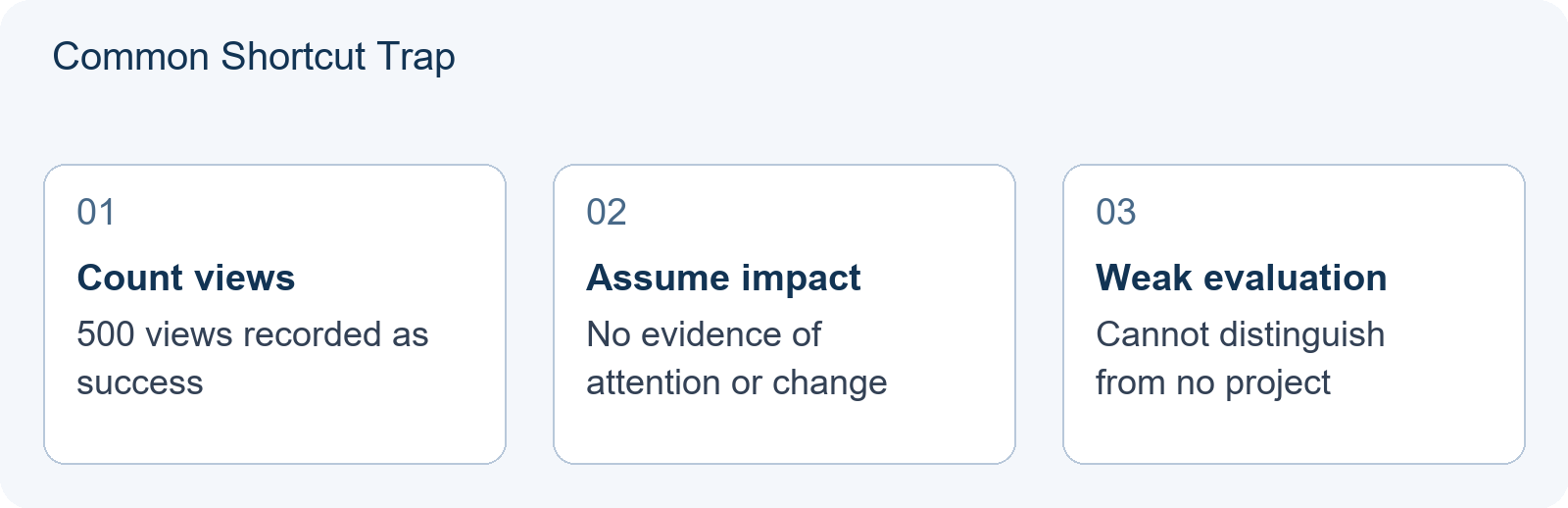
Consider a third hypothetical teaching illustration: a team reports, “Our PSA received 500 views and our health education session had 80 attendees. Therefore, our project was successful.” This evaluation fails at three levels:
| Shortcut | Why It Fails | Diagnostic Question |
|---|---|---|
| Views = Impact | Passive exposure does not indicate attention, understanding, or change | What fraction of viewers could recall one message at 24 hours? |
| Attendance = Learning | Presence does not distinguish engagement from obligation | What evidence shows attendees processed the content? |
| Activity = Outcome | Describing what the team did, not what changed for the audience | If the project had never happened, what would be different? |
The diagnostic table above is a teaching illustration for self-checking, not an official iHOSA requirement. Teams can adapt it to their own project stage.
Designing Your Own BCE Evaluation: A Practice Sequence
Based on the two worked examples, here is a suggested sequence for building project-specific evaluation:
- Define one target behavior. Not “raise awareness” but “reduce phone use before sleep” or “select lower-sugar beverages.”
- Identify the smallest group you can measure. One classroom, one club, one lunch period. Precision beats scale in project evaluation.
- Match indicator to resource. No survey budget? Use observed behavior. No access to records? Use structured self-report with a credibility check.
- Report limitations explicitly. State what you cannot know, not just what you found. This strengthens your evaluation rather than weakening it.
For guidance on selecting between the two deliverable formats, see iHOSA BCE Deliverable Formats: Choosing Between a PSA and a Health Education Class.
What to Prepare Before Asking for Feedback
If you plan to consult a mentor or teacher about your BCE project evaluation, bring:
- Your draft target behavior statement (one sentence)
- One feasible indicator and how you would collect it
- One limitation you already recognize
This preparation allows focused feedback on your logic rather than generic advice. It also demonstrates the project-management skill that BCE evaluation is designed to build.
Skill Checkpoint
After working through the examples above, a learner should be able to: distinguish between output metrics (what the team produced) and outcome metrics (what changed for the audience); design at least two indicators for a hypothetical BCE project that do not rely on headcount; identify the main limitation in a given evaluation plan; and explain why a decline in one indicator (like the phone-lockbox participation drop from 60% to 45%) does not automatically invalidate a project but rather points to where follow-up is needed.
Frequently Asked Questions
Does iHOSA require a specific evaluation format for BCE projects?
No official format is specified in the source materials reviewed. The evaluation approaches described here are teaching illustrations designed to strengthen project logic, not mandated structures.
Can I use online survey tools for my BCE project evaluation?
Yes, though the article emphasizes matching your indicator to available resources. If using surveys, consider a credibility check such as an embedded attention question or a follow-up verification step.
How small can my measured group be?
A single classroom or comparable group is sufficient for project-level evaluation. The examples above use n≈30 and n≈80 respectively. Precision in measurement matters more than large numbers.

Oct 20, 2026
iHOSA ATC Division I vs II: Allocating Study Time by Weighting Differences
Students in grades 9-10 and 11-12 face different topic weightings in the iHOSA ATC Biology and Chemistry exams. This guide breaks down…
Oct 17, 2026
iHOSA Biology Explanations: Connect a Feedback Loop to a Change in the Body
Mastering negative and positive feedback loops is essential for iHOSA Biology. Learn how to connect physiological mechanisms to observable changes with worked…
Oct 15, 2026
iHOSA Health Education: Test Whether an Audience Understood Your Message
In iHOSA Health Education, testing whether your audience understood your message is not an afterthought—it is the core deliverable. Learn how to…